Introduction
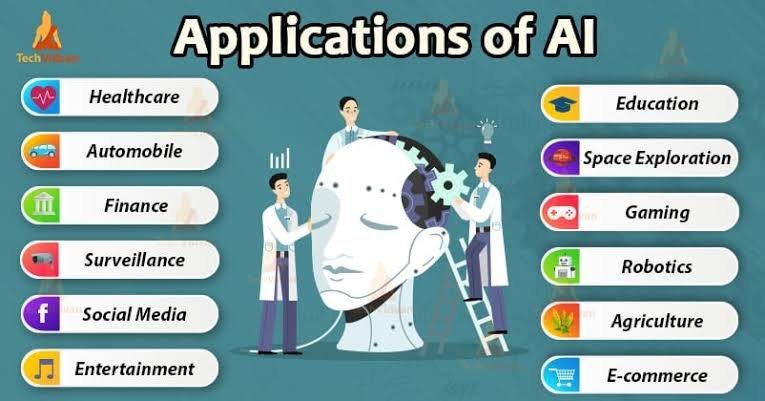
Artificial Intelligence (AI) is becoming an important part of our everyday lives. It allows machines and computer systems to perform tasks that normally require human intelligence. Today, AI Applications are transforming different industries by making work faster, easier, and more efficient. From healthcare and education to business and entertainment, AI is helping people solve problems and make better decisions. As technology continues to develop, its role in our daily lives is becoming increasingly valuable.
1. Understanding AI Applications
AI Applications refer to the practical uses of artificial intelligence in different areas of life. These applications help computers understand information, recognize patterns, solve problems, and perform tasks automatically. AI technology uses machine learning, natural language processing, and other advanced techniques to deliver useful results. Businesses, organizations, and individuals use AI tools to save time, improve productivity, and achieve better outcomes.
2. AI Applications in Healthcare
Healthcare is one of the most important fields where artificial intelligence is making a positive difference. AI-powered systems help doctors analyze medical reports, identify possible diseases, and examine medical images. These technologies can also support the development of personalized treatment plans. AI chatbots and virtual health assistants provide basic health information and help patients manage appointments. Although AI cannot replace medical professionals, it can support them in providing better healthcare services.
3. AI Applications in Education
Artificial intelligence is changing the way students learn and teachers deliver lessons. AI-powered educational platforms provide personalized learning experiences according to individual student needs. Students can use AI tools to understand difficult topics, improve their writing, and practice new skills. Teachers can also use AI to prepare learning materials, evaluate assignments, and manage classroom activities. These applications make education more flexible, accessible, and interactive.
4. AI Applications in Business
Modern businesses are increasingly using AI to improve their daily operations. Artificial intelligence helps companies analyze customer behavior, manage large amounts of information, and identify market trends. AI-powered software can automate repetitive tasks, allowing employees to focus on more important responsibilities. Businesses also use AI chatbots to answer customer questions and provide support around the clock. As a result, companies can improve customer satisfaction and increase overall efficiency.
5. AI Applications in Banking and Finance
The banking and financial industries benefit greatly from artificial intelligence. Banks use AI systems to monitor financial transactions, identify unusual activities, and detect potential fraud. AI can also help customers manage their accounts through virtual assistants and automated support services. Financial organizations use predictive analysis to understand market trends and evaluate financial risks. These applications make financial services more convenient, accurate, and secure.
6. AI Applications in Transportation
Transportation is another industry experiencing significant improvements through artificial intelligence. AI-powered navigation systems help drivers find suitable routes and avoid traffic congestion. Transportation companies use AI to manage delivery schedules, monitor vehicles, and improve logistics operations. Advanced driver assistance systems can also identify road obstacles and provide safety warnings. These technologies contribute to more organized transportation systems and better travel experiences.
7. AI Applications in Marketing
Artificial intelligence has become a useful tool in digital marketing and advertising. Companies use AI to understand customer interests, study shopping habits, and create more relevant advertisements. AI tools can also help marketers generate content ideas, analyze campaign performance, and identify potential customers. Social media platforms use artificial intelligence to recommend posts, videos, and products based on user preferences. This allows businesses to develop more effective marketing strategies.
8. AI Applications in Agriculture
Agriculture is benefiting from AI technologies that help farmers improve productivity and manage resources. AI-powered tools can analyze weather conditions, monitor soil quality, and identify plant diseases. Smart farming systems use sensors and data analysis to determine when crops need water or fertilizer. Farmers can also use AI-powered drones to monitor large agricultural areas. These applications support better farming decisions, reduce resource waste, and improve crop management.
9. AI Applications in Entertainment
Artificial intelligence plays an important role in the entertainment industry. Streaming platforms use AI algorithms to recommend movies, television shows, and music according to individual preferences. AI tools also support video editing, animation, sound production, and visual effects. Content creators can use these technologies to develop creative ideas and improve their production processes. As a result, entertainment experiences are becoming more personalized and engaging.
10. AI Applications in Cybersecurity
Cybersecurity professionals use artificial intelligence to identify and respond to digital threats. AI systems can examine network activities, recognize unusual behavior, and detect suspicious login attempts. They help organizations monitor their digital environments and identify potential security weaknesses. AI-powered security tools can also assist in detecting malware and preventing unauthorized access. However, human experts remain essential for reviewing security alerts and making important decisions.
11. Benefits and Challenges of AI Applications
AI Applications offer several benefits, including improved productivity, faster data processing, reduced manual work, and better decision-making. They help organizations complete complex tasks and provide services more efficiently. However, artificial intelligence also creates certain challenges, such as data privacy concerns, cybersecurity risks, job displacement, and inaccurate results. Some AI systems may produce biased information if they are trained on unsuitable data. Therefore, responsible development and proper human supervision are necessary.
12. Future of AI Applications
The future of AI Applications looks promising as technology continues to advance. Artificial intelligence may become even more useful in healthcare, education, scientific research, environmental protection, and other important fields. New AI systems are expected to provide more accurate information and help people complete complicated tasks. At the same time, governments and organizations will need to establish suitable rules to ensure responsible AI development. With the right balance between innovation and human control, AI can contribute to a better future.
Conclusion
AI Applications are changing the modern world by improving the way people work, learn, communicate, and solve problems. They provide valuable support across industries, including healthcare, education, business, transportation, and agriculture. Despite challenges related to privacy, security, and employment, artificial intelligence offers many opportunities for progress. Using AI responsibly can help individuals and organizations achieve better results. Overall, AI will continue to play an important role in shaping the future of technology and society.
Frequently Asked Questions (FAQs)
1. What are AI Applications?
AI Applications are tools, software, and technologies that use artificial intelligence to perform tasks such as analyzing information, recognizing patterns, answering questions, and making predictions.
2. What are the most common uses of AI Applications?
Common uses include healthcare diagnosis support, online education, customer service, banking security, digital marketing, transportation, entertainment recommendations, and smart agriculture.
3. What are the main benefits of AI Applications?
The main benefits include saving time, increasing productivity, reducing repetitive work, improving accuracy, supporting decision-making, and providing personalized services.